
The email looked fine at first glance. It was polite, formatted correctly, and even mentioned the recent campaign. But something was missing. Continue reading

Estimated reading time: 4 minutes
The development director stared at her screen.
She had 20 minutes before her next meeting, a thank-you email to send to 150 donors, and a social post that still needed approval. The big report due Friday? Not even started.
She didn’t need a revolution. She needed an extra hour….or three. Continue reading
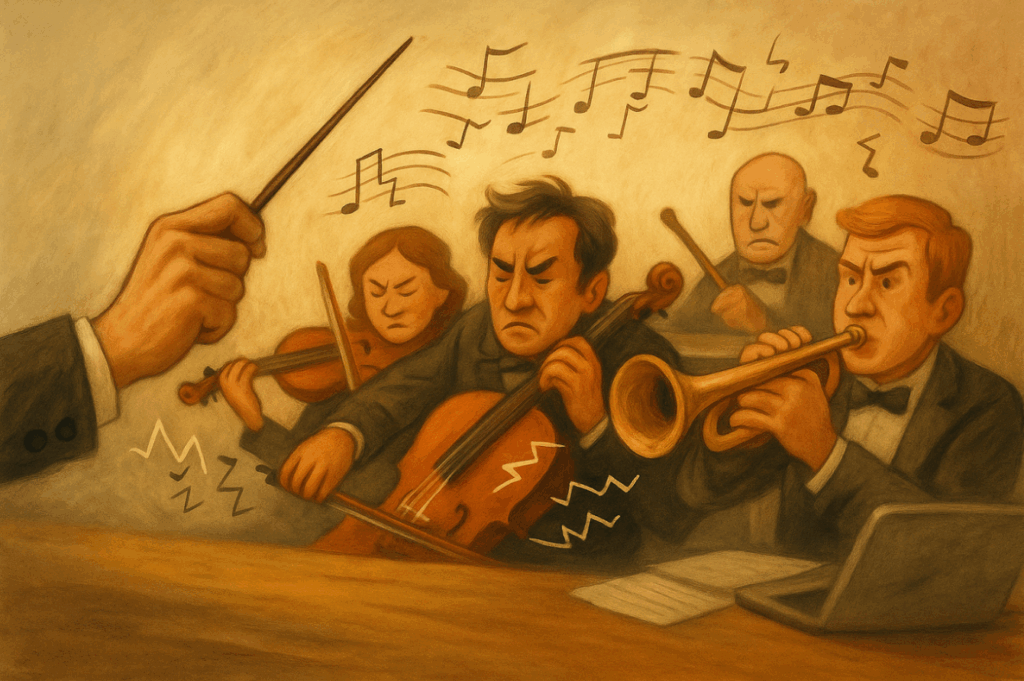
The orchestra was talented, but the first run-through was rough.
The string section surged ahead. The horns came in a beat late. The percussionist, unsure of the tempo, hesitated just long enough to throw the rhythm off. Each musician knew their part. But without a clear downbeat, they weren’t playing together.
Then the conductor raised the baton—not to control, but to align.
Suddenly, everything locked in. Same people. Same instruments. Just clearer timing and shared cues.
That’s what happens when your team starts using AI without a shared framework. Everyone’s contributing. Everyone’s moving fast. But without a consistent guide for voice, timing, and message, your communications don’t land in sync.
Without a shared sense of timing and tone, your messages don’t just sound off. They feel scattered. Like something important got lost in translation—even if technically, the words are fine.
What changes things isn’t more control. It’s the quiet clarity of a well-timed cue, offered early, repeated often, and trusted by everyone.
In nonprofit communications, that shared downbeat looks like clear approvals, trusted templates, and a rhythm your team can move to—even when the pace picks up.
Scaling Isn’t the Problem. Scaling Inconsistently Is.
When nonprofits start using AI to scale content, they often worry they’ll lose control. That donor messages will sound off. That AI will get the tone wrong. That the output will drift into something too generic—or too robotic.
The worry isn’t wrong. It’s just misplaced.
The problem isn’t scale. It’s that things get weird when you scale without guardrails. Messages start slipping sideways. People ask, “Wait, was that really from us?”
When more people and tools are creating content faster, you don’t just need more rules—you need shared references. Lightweight guides. Examples that help the humans and the machines know what “good” looks like for your brand.
The Scalable Voice Toolkit
If you’ve already created some foundational tools, like a message library, red-flag list, or AI prompt bank (from Installment 2), you’re halfway there.
The following suggestions aren’t just tips, they’re tools to keep your voice steady as you scale.
Approval Guidelines
Not every piece of AI-generated content needs full review. Create tiers:
- Green: Social blurbs, event copy: Auto-send
- Yellow: Donor emails: Light Review
- Red: Executive communications: Always Review
Make the criteria clear so your team can move with confidence. Even something as simple as a tiered review chart in a shared Google Doc, color-coded by content type, can help. When everyone knows what needs a second set of eyes (and what doesn’t), it cuts down on approvals and reduces brand drift. Small structure, big impact.
Spot Checks for Voice Drift
Build in 15-minute “voice check” windows once a month.
Pull up a few recent emails or social posts and ask: Does this sound like us? Are we repeating what matters? Or drifting into autopilot?
Prompt Refinement Loops
Treat your AI prompt library as a living document. After each campaign or big push, note what worked. What missed. Keep evolving your AI prompts to reflect your brand voice, not just your to-do list.
Shared Language for Brand Voice
Teach your team what “off-brand” sounds like, not just what to say.
Create before/after examples of tone, rhythm, and structure. Invite feedback and questions. The more familiar the team is with your voice, the easier it is to maintain, even when AI is in the mix.
The Goal Isn’t Control. It’s Confidence.
You don’t need to review every word your team writes or every sentence an AI communication tool generates. You just need to give them something to align to.
That’s what makes scale possible, without compromising clarity, tone, or mission.
If this sounds familiar, you’re not alone.
We’re building ConnectionWorks to help teams like yours stay grounded in what matters, without falling behind. Book a quick walkthrough →
This is the third post in our series on helping nonprofits prepare for AI in a way that strengthens clarity, protects voice, and aligns with mission.

You’re trying to coordinate a volunteer event with a group of people.
One person sends a group text. Another follows up with an email. A third drops a time and location in a calendar invite—but it doesn’t match either of the first two.
Nobody’s being careless. Everyone’s trying to help. But no one’s on the same page.
The result? Confusion. Mixed messages. A few people show up late, one person goes to the wrong place, and everyone ends up a little frustrated—not because they didn’t care, but because the message wasn’t consistent. Continue reading

During the Apollo 13 mission, an explosion crippled the spacecraft more than 200,000 miles from Earth. With limited power and a damaged oxygen supply, the NASA team had to act fast. But they didn’t start with bold new solutions. They started with what they had: duct tape, slide rules, coffee, and calm. They didn’t aim for perfection—they aimed to keep the mission alive. Continue reading


Estimated reading time: 3 minutes
When the creators of Jurassic Park first unveil their groundbreaking achievement—real, living dinosaurs—the reaction is awe. But the admiration quickly turns to alarm. Around a boardroom table, chaos theory expert Dr. Ian Malcolm cuts through the excitement with a warning: “Your scientists were so preoccupied with whether or not they could, they didn’t stop to think if they should.”
Continue reading

In Field of Dreams, Ray Kinsella, a farmer haunted by a mysterious voice, hears the words: “If you build it, he will come.” What follows is a quiet act of courage. Ray tears up his crops to construct a baseball diamond—no audience, no funding, no guarantees. Neighbors dismiss him. Financial stress mounts. But he keeps building, led by conviction. Continue reading

It Started With Coffee and a Question
Before launching a campaign to expand local food access, the nonprofit team behind the project did something unusual: they paused.
Instead of diving into outreach, they invited a handful of longtime supporters to a Saturday morning coffee meet-up. No agenda. Just one question: “What’s this work meant to you—and where do you want to see it go next?” Continue reading